

Deburring with cobots
Precise edge quality without manual reworking
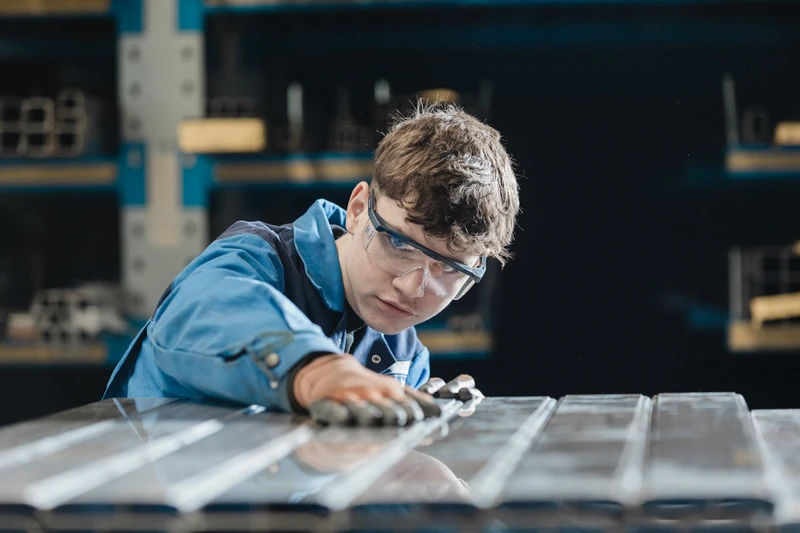
Manual deburring of components with a hand file is often the bottleneck in production. It is a monotonous, strenuous movement that strains the joints and where quality depends heavily on the employee's daily form. In addition, there is a high risk of injury from slipping on sharp edges.
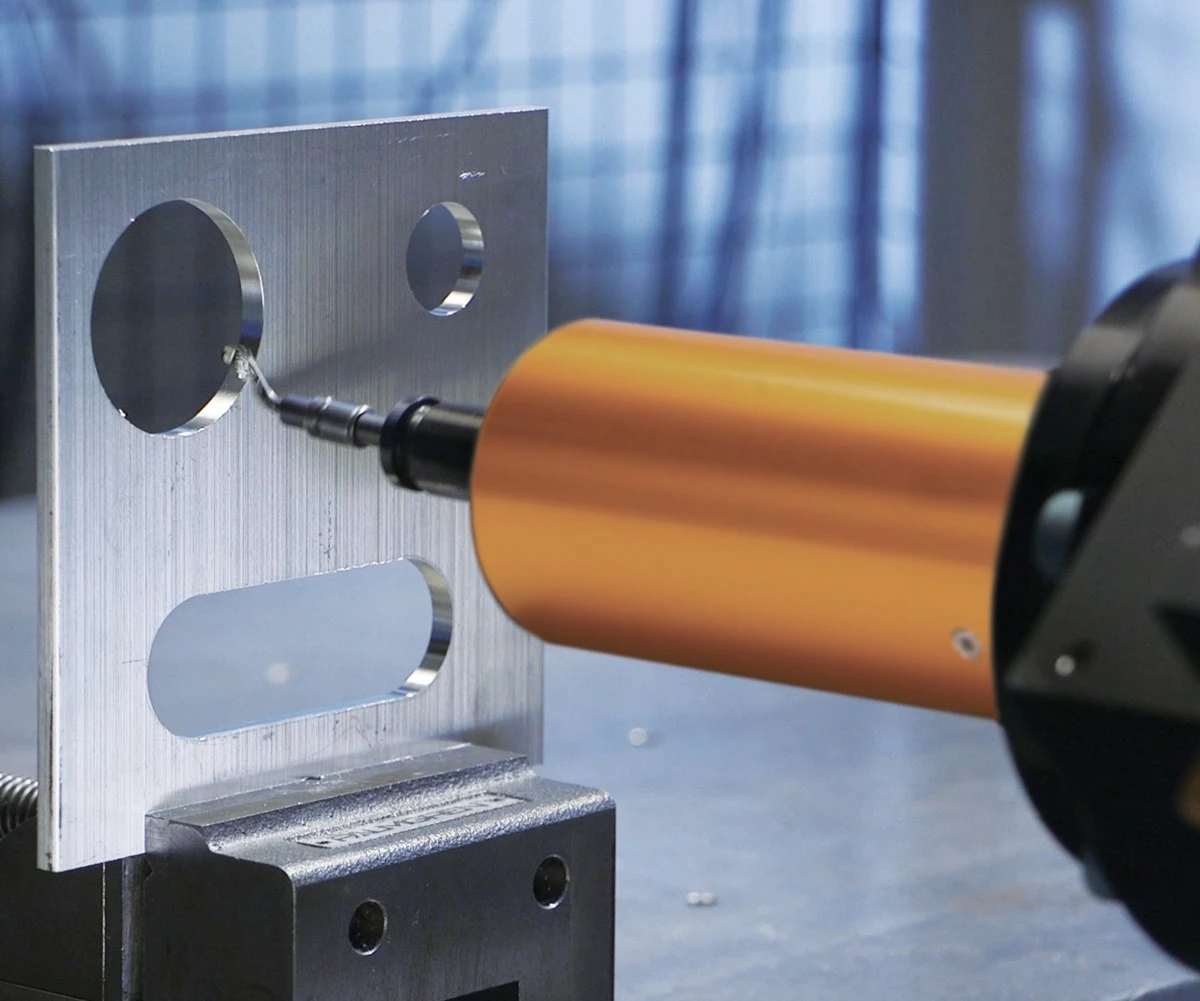
Cobots offer the ideal solution here: equipped with specialized filing tools, they precisely follow the contours of your components. They ensure that every edge is broken exactly the same way—component by component, with maximum repeatability and without fatigue.
Get in touch with usThe advantages
Consistent quality: A robot does not produce "Monday products." It always applies the file to the edge with the same pressure. This guarantees consistent results that precisely meet your tolerance specifications.
Health protection: Free your team from "backbreaking work" and the risk of "white finger" (caused by vibrations) or cuts. The cobot takes over the work directly on the component, while your skilled workers take care of quality control.
Cost-effectiveness: Manual deburring is time-consuming. A cobot often works in parallel with the CNC machine during prime time: while the machine produces the next part, the robot deburrs the previous one. This saves a lot of personnel costs.
Challenges
Deburring is often considered the "supreme discipline" because components are never 100% identical. We have the technical solutions for these hurdles:
Varying component tolerances
Cast or plastic parts often have slight dimensional deviations or burrs in different places. A rigid robot would either remove too much material or miss the burr. The solution: we use tools with integrated compliance. The filing tool "springs" radially. It presses against the component with constant force and mechanically compensates for positional errors or tolerances without the robot arm having to readjust.
Complex programming of contours
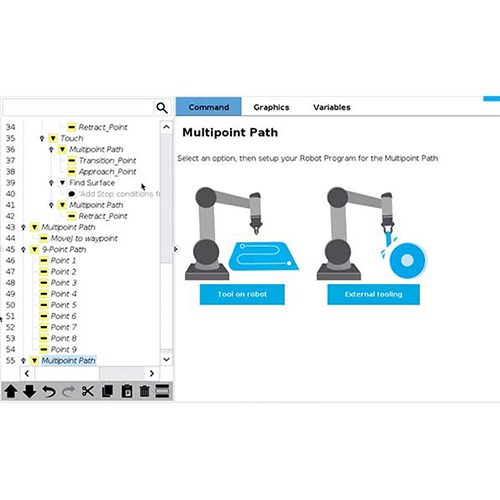
Do I have to program each curve individually? The solution: No. With modern path detection tools, you guide the robot arm along the edge once by hand. Alternatively, we use the simple waypoint programming of the UR cobots. Since the tool is tolerant, the path does not have to be accurate to a hundredth of a millimeter—this makes programming much easier.
Tool wear
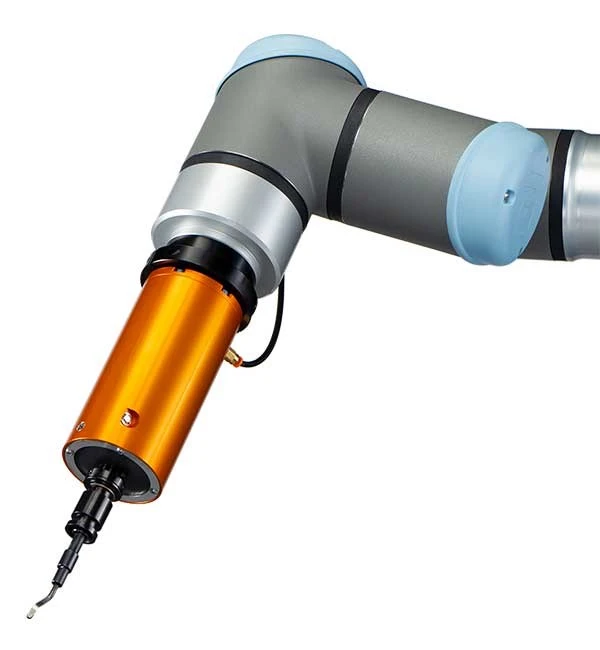
Aluminum today, plastic tomorrow? The solution: Modern deburring end effectors for cobots are versatile. By adjusting the air pressure, the contact force (rigidity) can be regulated so that you can gently deburr both hard metals and softer plastics.
Experience UR cobots in action
Book a cobot demoSuitable technologies
Not all deburring is the same. Depending on the material and burr thickness, you need different approaches. We therefore offer two specialized tool solutions from ATI that mechanically compensate for tolerances ("compliance") but work in different ways.
cobot
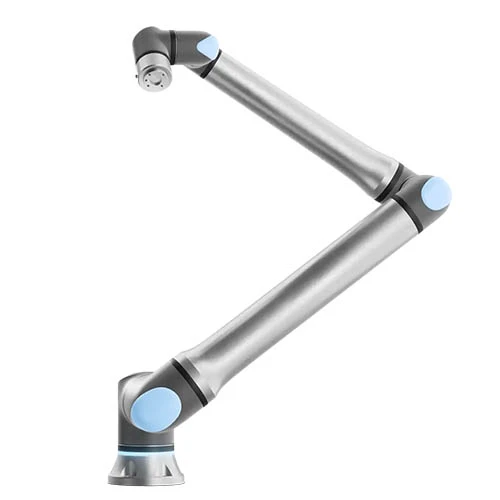
Universal Robots cobots are ideal for deburring. Their integrated force/torque sensor in the flange enables the robot to follow contours with sensitivity. The robot arm is also robust enough to withstand the vibrations of the deburring process over long periods. There are variants with a wide range of reach options.
About cobots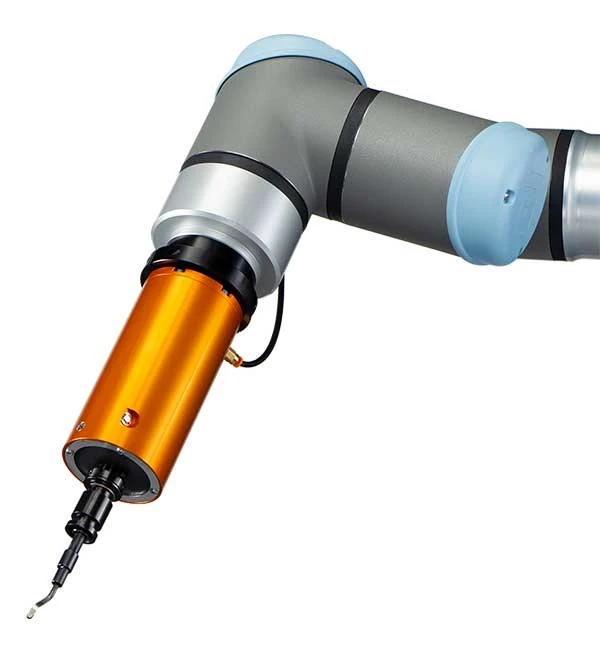
Deburring tools
Depending on the material and burr thickness, we integrate the appropriate technology from the UR+ ecosystem:
- Spindles & brushes: Rotating tools for surface removal or rounding hard burrs.
- Files & blades: Oscillating or spring-loaded tools for precise contour machining. Compliance is often a decisive factor: many of these tools are mechanically spring-loaded to automatically compensate for component tolerances.
Software & Accessories
The programming of complex contours is greatly simplified by path recording tools: you guide the arm along the edge once, and the software remembers the path. The cell is often supplemented by simple accessories such as compressed air cleaning stations for the files.
Accessoriessolution finding
1. Edge analysis We examine your component: What material needs to be processed? How much does the burr vary? Is it sufficient to scrape the edge, or does material need to be filed off?
2. Tool selection Based on the analysis, we select the appropriate category: an oscillating tool for rough work or a blade-based tool for a fine finish.
3. Process optimization In trials, we determine the ideal contact pressure (controlled via air pressure) and the travel speed of the robot in order to achieve the desired cycle time.
4. Integration We integrate the cobot into your line—either as a standalone deburring station or directly on the CNC machine, where the robot combines feeding and deburring.


Get in touch with us